The southern astronomer is based in Florida and regularly posts information for those who are interested in the fields of astronomy and cosmology.
Showing posts with label universe. Show all posts
Thursday, January 26, 2017
The Expanding Universe Revealed
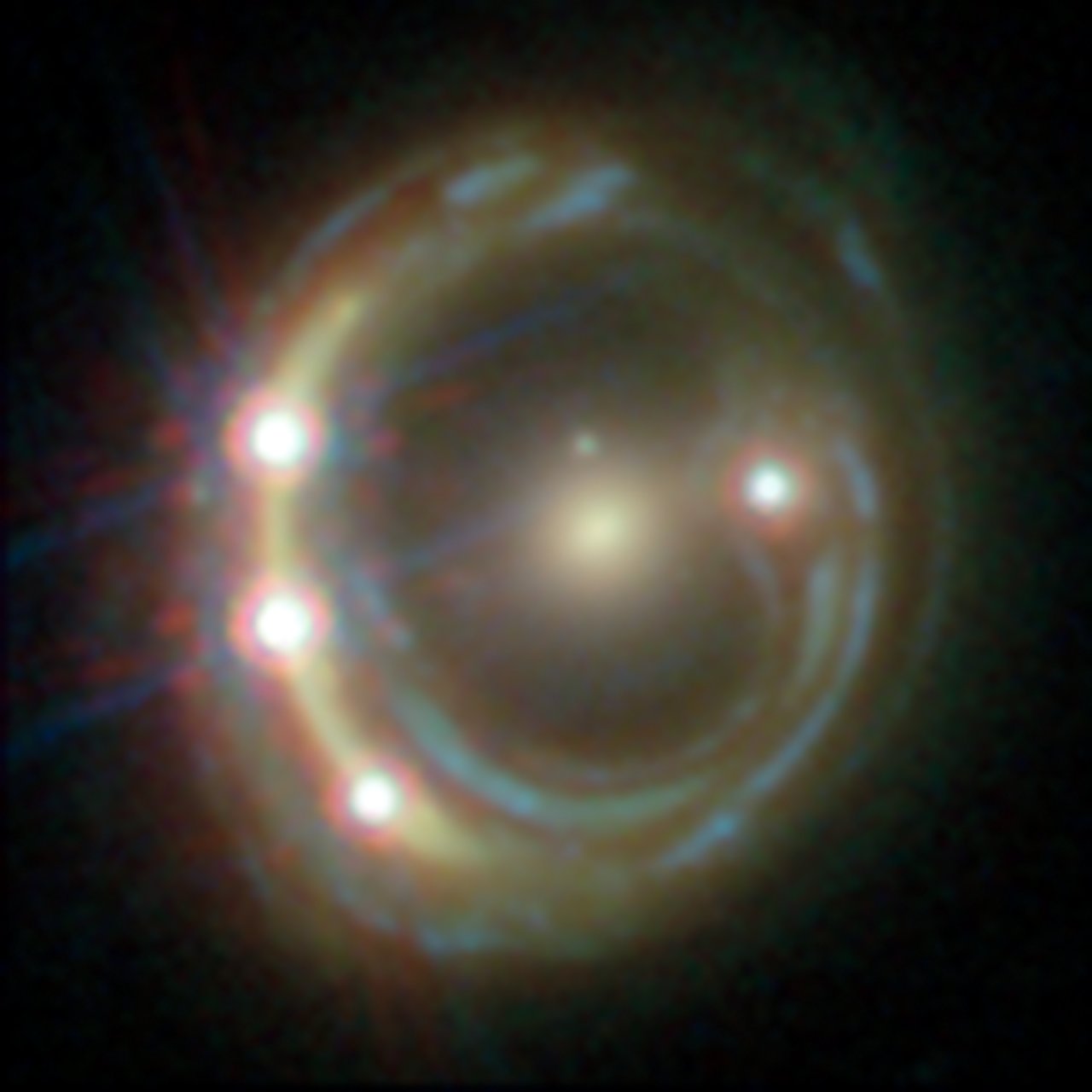
Hubble Space Telescope view of the distant quasar RXJ1131-1231. A foreground galaxy smears the image of the background quasar into a bright arc (left) and creates a total of four images — a phenomenon known as gravitational lensing. Such lensed views allowed scientists to come up with a new estimate for how fast the universe is expanding
Read the entire article:
http://www.space.com/35463-universe-expansion-in-quasars-hubble-photos.html
Monday, December 19, 2016
A universe made for me? Physics, fine-tuning and life
Geraint F. Lewis’ day job involves creating synthetic universes on supercomputers. They can be overwhelmingly bizarre, unstable places. The question that compels him is: how did our universe come to be so perfectly tuned for stability and life?
For more than 400 years, physicists treated the universe like a machine, taking it apart to see how it ticks. The surprise is it turns out to have remarkably few parts: just leptons and quarks and four fundamental forces to glue them together.
But those few parts are exquisitely machined. If we tinker with their settings, even slightly, the universe as we know it would cease to exist. Science now faces the question of why the universe appears to have been “fine-tuned” to allow the appearance of complex life, a question that has some potentially uncomfortable answers.
For more than 400 years, physicists treated the universe like a machine, taking it apart to see how it ticks. The surprise is it turns out to have remarkably few parts: just leptons and quarks and four fundamental forces to glue them together.
But those few parts are exquisitely machined. If we tinker with their settings, even slightly, the universe as we know it would cease to exist. Science now faces the question of why the universe appears to have been “fine-tuned” to allow the appearance of complex life, a question that has some potentially uncomfortable answers.
Monday, November 21, 2016
How Can the Universe Expand Faster Than the Speed of Light?
It seems like it should be illegal, doesn’t it? Over and over (and over and over) we're told the supreme iron law of the universe: Nothing — absolutely nothing — can go faster than the speed of light. Done. Nothing further needs to be said about the issue.
And then come the astronomers, always excited by the chance to mess up your comfort zone. They come barging in with a simple observation: Some galaxies are moving away from us…wait for it…faster than the speed of light. What gives?
The big picture
First off, it's important to note that we live in an expanding universe. Every day the galaxies get farther apart from each other — on average. There are slight motions on top of that general expansion, leading to instances such as the Andromeda Galaxy heading on a collision course for the Milky Way. But in general, in the biggest of pictures, the galaxies are getting farther away from each other.
And then come the astronomers, always excited by the chance to mess up your comfort zone. They come barging in with a simple observation: Some galaxies are moving away from us…wait for it…faster than the speed of light. What gives?
The big picture
First off, it's important to note that we live in an expanding universe. Every day the galaxies get farther apart from each other — on average. There are slight motions on top of that general expansion, leading to instances such as the Andromeda Galaxy heading on a collision course for the Milky Way. But in general, in the biggest of pictures, the galaxies are getting farther away from each other.
Tuesday, November 3, 2015
Mystery bright spots could be first glimpse of another universe
Scientists find odd bright spots, could be another universe bumping into ours
Mystery bright spots could be first glimpse of another universe
Spectral Variations of the Sky: Constraints on Alternate Universes
Mystery bright spots could be first glimpse of another universe
Spectral Variations of the Sky: Constraints on Alternate Universes
Friday, July 31, 2015
Is Our Universe Simulated? Seriously...
I began bemused. The notion that humanity might be living in an artificial reality — a simulated universe — seemed sophomoric, at best science fiction.
But speaking with scientists and philosophers on "Closer to Truth," I realized that the notion that everything humans see and know is a gigantic computer game of sorts, the creation of supersmart hackers existing somewhere else, is not a joke. Exploring a "whole-world simulation," I discovered, is a deep probe of reality.
David Brin, sci-fi writer and space scientist, relates the Chinese parable of an emperor dreaming that he was a butterfly dreaming that he was an emperor. In contemporary versions, Brin said, it may be the year 2050 and people are living in a computer simulation of what life was like in the early 21st century — or it may be billions of years from now, and people are in a simulation of what primitive planets and people were once like.
But speaking with scientists and philosophers on "Closer to Truth," I realized that the notion that everything humans see and know is a gigantic computer game of sorts, the creation of supersmart hackers existing somewhere else, is not a joke. Exploring a "whole-world simulation," I discovered, is a deep probe of reality.
David Brin, sci-fi writer and space scientist, relates the Chinese parable of an emperor dreaming that he was a butterfly dreaming that he was an emperor. In contemporary versions, Brin said, it may be the year 2050 and people are living in a computer simulation of what life was like in the early 21st century — or it may be billions of years from now, and people are in a simulation of what primitive planets and people were once like.
Monday, February 9, 2015
No Big Bang? Quantum equation predicts universe has no beginning
The universe may have existed forever, according to a new model that applies quantum correction terms to complement Einstein's theory of general relativity. The model may also account for dark matter and dark energy, resolving multiple problems at once.
The widely accepted age of the universe, as estimated by general relativity, is 13.8 billion years. In the beginning, everything in existence is thought to have occupied a single infinitely dense point, or singularity. Only after this point began to expand in a "Big Bang" did the universe officially begin.
Although the Big Bang singularity arises directly and unavoidably from the mathematics of general relativity, some scientists see it as problematic because the math can explain only what happened immediately after—not at or before—the singularity.
"The Big Bang singularity is the most serious problem of general relativity because the laws of physics appear to break down there," Ahmed Farag Ali at Benha University and the Zewail City of Science and Technology, both in Egypt, told Phys.org.
Ali and coauthor Saurya Das at the University of Lethbridge in Alberta, Canada, have shown in a paper published in Physics Letters B that the Big Bang singularity can be resolved by their new model in which the universe has no beginning and no end.
Read the entire article: http://phys.org/news/2015-02-big-quantum-equation-universe.html#jC

The widely accepted age of the universe, as estimated by general relativity, is 13.8 billion years. In the beginning, everything in existence is thought to have occupied a single infinitely dense point, or singularity. Only after this point began to expand in a "Big Bang" did the universe officially begin.
Although the Big Bang singularity arises directly and unavoidably from the mathematics of general relativity, some scientists see it as problematic because the math can explain only what happened immediately after—not at or before—the singularity.
"The Big Bang singularity is the most serious problem of general relativity because the laws of physics appear to break down there," Ahmed Farag Ali at Benha University and the Zewail City of Science and Technology, both in Egypt, told Phys.org.
Ali and coauthor Saurya Das at the University of Lethbridge in Alberta, Canada, have shown in a paper published in Physics Letters B that the Big Bang singularity can be resolved by their new model in which the universe has no beginning and no end.
Read the entire article: http://phys.org/news/2015-02-big-quantum-equation-universe.html#jC
Thursday, September 18, 2014
What Is the Universe? Real Physics Has Some Mind-Bending Answers
Science says the universe could be a hologram, a computer program, a black hole or a bubble—and there are ways to check...
The questions are as big as the universe and (almost) as old as time: Where did I come from, and why am I here? That may sound like a query for a philosopher, but if you crave a more scientific response, try asking a cosmologist.
This branch of physics is hard at work trying to decode the nature of reality by matching mathematical theories with a bevy of evidence. Today most cosmologists think that the universe was created during the big bang about 13.8 billion years ago, and it is expanding at an ever-increasing rate. The cosmos is woven into a fabric we call space-time, which is embroidered with a cosmic web of brilliant galaxies and invisible dark matter.
It sounds a little strange, but piles of pictures, experimental data and models compiled over decades can back up this description. And as new information gets added to the picture, cosmologists are considering even wilder ways to describe the universe—including some outlandish proposals that are nevertheless rooted in solid science.
Read more:
http://www.smithsonianmag.com/science/what-universe-real-physics-has-some-mind-bending-answers-180952699
The questions are as big as the universe and (almost) as old as time: Where did I come from, and why am I here? That may sound like a query for a philosopher, but if you crave a more scientific response, try asking a cosmologist.
This branch of physics is hard at work trying to decode the nature of reality by matching mathematical theories with a bevy of evidence. Today most cosmologists think that the universe was created during the big bang about 13.8 billion years ago, and it is expanding at an ever-increasing rate. The cosmos is woven into a fabric we call space-time, which is embroidered with a cosmic web of brilliant galaxies and invisible dark matter.
It sounds a little strange, but piles of pictures, experimental data and models compiled over decades can back up this description. And as new information gets added to the picture, cosmologists are considering even wilder ways to describe the universe—including some outlandish proposals that are nevertheless rooted in solid science.
Read more:
http://www.smithsonianmag.com/science/what-universe-real-physics-has-some-mind-bending-answers-180952699
Saturday, February 22, 2014
Alternatives to the Big Bang Theory Explained (Infographic)
Nearly 14 billion years ago, there was nothing and nowhere. Then, due to a random fluctuation in a completely empty void, a universe exploded into existence. Something the size of a subatomic particle inflated to unimaginably huge size in a fraction of a second, driven apart by negative-pressure vacuum energy. Scientists call this theory for the origin of the universe the Big Bang.
What we call the "observable universe" (or the "Hubble Volume") is the spherical region, about 90 billion light-years in diameter, that is centered on any given observer. This is the only part of the universe in which light has had time to reach the observer in the 13.8 billion years since the universe began.
Since the universe's expansion is accelerating, objects are being dragged out of Earth's Hubble Volume and will become undetectable to humans of the future.
What we call the "observable universe" (or the "Hubble Volume") is the spherical region, about 90 billion light-years in diameter, that is centered on any given observer. This is the only part of the universe in which light has had time to reach the observer in the 13.8 billion years since the universe began.
Since the universe's expansion is accelerating, objects are being dragged out of Earth's Hubble Volume and will become undetectable to humans of the future.
Wednesday, January 22, 2014
Astronomers Capture The First Image Of The Mysterious Web That Connects All Galaxies In The Universe
For the first time, astronomers were able to see a string of hot gas known as a filament that is thought to be part of the mysterious underlying structure that dictates the layout of all the stars and galaxies in our universe.
Scientists believe that matter in the universe is arranged into a gigantic web-like structure. This is called the cosmic web.
There are signatures of this structure in the remaining radiation from the Big Bang and in the layout of the universe itself. Without some mysterious force pulling visible matter into this web, galaxies would be randomly scattered across the universe. But they aren't.
We can see that galaxies are found in groups and those groups come together in larger clusters.
Computer models tell us that those galaxy clusters are linked by long filaments of hot gas and dark matter — a mystery substance that we can't see because it doesn't radiate or scatter light but that makes up most of the web.
Read more:
http://www.businessinsider.com/first-image-of-cosmic-web-2014-1#ixzz2r8g18jYL
Scientists believe that matter in the universe is arranged into a gigantic web-like structure. This is called the cosmic web.
There are signatures of this structure in the remaining radiation from the Big Bang and in the layout of the universe itself. Without some mysterious force pulling visible matter into this web, galaxies would be randomly scattered across the universe. But they aren't.
We can see that galaxies are found in groups and those groups come together in larger clusters.
Computer models tell us that those galaxy clusters are linked by long filaments of hot gas and dark matter — a mystery substance that we can't see because it doesn't radiate or scatter light but that makes up most of the web.
Read more:
http://www.businessinsider.com/first-image-of-cosmic-web-2014-1#ixzz2r8g18jYL
Subscribe to:
Posts (Atom)